
On the Invasion Beaches
SWORD Beach
So, it was off t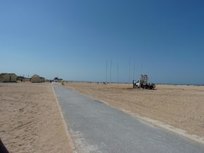 o the beaches.
Our first stop was SWORD beach – near the port of Ouistreham – which was almost empty.
On our way back to the car, we passed a relic of the Atlantic Wall – the German shore defences. It was either a machine gun or observation post with a view along the beach. In contrast to this sym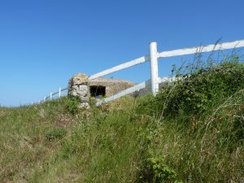 bol of war, we then saw some Frenchmen engaged in that most peaceful of games – Boules
Next we went to th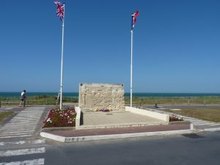 e memorial to the Commandos of the 1st Special Service Brigade .This is near to the junction of QUEEN and ROGER sections of SWORD beach. Directly opposite, with typical French ingenuity, the
 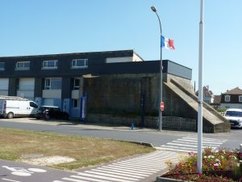 75mm casemate of German Strongpoint WN-18 has been incorporated into a house!
JUNO Beach
We stopped for a well-deserved ice cream. Then we drove a little further along the coast to Courseulles-sur-Mer. This is more or less is at the centre of JUNO beach on which the Canadian 3rd Infantry Division landed.
Here is a more unusual version of the Sherman tank – a DD or Duplex Drive tank.
[you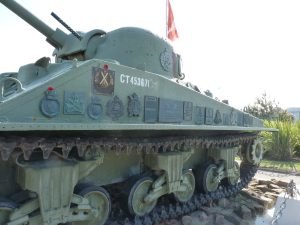 tube]https://www.youtube.com/watch?v=3XuSneN1W8U[/youtube]
The Army modified these tanks for water borne assaults by welding a frame to the hull just above the tracks, to which was fitted a canvas screen. This screen extended to above the turret. As a result, the tanks could be floated off landing craft out at sea. They would “swim” into shore using propellers fitted to the rear of the tank. The idea being that they would land either just in front of, or with, the infantry to offer immediate tank support. Unfortunately, this particular one didn’t make it on the day and was recovered 26 years later. Now numerous plaques to commemorate the various Canadian units involved in the Normandy Campaign adorn it. However, it was originally from the 1st Hussars of the 6th Canadian Armoured Regiment.
Dustbins can fly
Near Graye-sur-Mer by the first exit from the landings to be opened on JUNO beach is a Churchill tank. Those of you familiar with the Churchill tank will notice something rather unusual about the gun on this particular tank. Comparatively speaking, it’s huge! This is because it’s a 290mm Petard Mortar, firing a shell known affectionately as a “Flying Dustbin”, designed to blast through concrete bunkers and 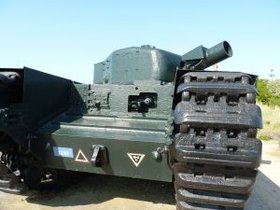 buildings. Along with the Sherman DD tank mentioned earlier, it was one of “Hobart’s Funnies”. Named after General Percy Hobart of the 79th Armoured Division. Under who’s command all of these unusual vehicles were.
GOLD Beach
Moving on to the last of our beaches, we come back into “proper” Men in the Shed territory, although I hope that you’ve enjoyed the diversions! A number of the men held in the shed were members of the British 50th Division. That Division came ashore on GOLD beach, which was wh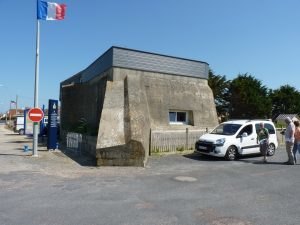 ere we now were.
Walking along the beach, we came to the base of the “Cercle Nautique de Ver sur Mer” – a sailing club. It is based in what was WN-33 at la Rivière, which was a 88mm gun emplacement. There is a photograph on the side of the current building which shows the area after it had been taken. Online I found an “artists impression” of what the fighting might have looked like on the day. Returning to the car we noticed the effects of heat expansion on the footpath.
As we drove back towards the hotel in Caen, we passed a “Sexton” self propelled 25pdr gun – designed to be able to keep up with tanks and provide artillery support.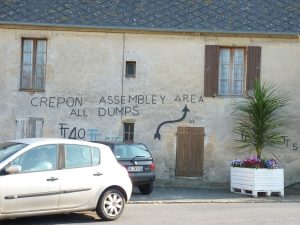
We drove through Ver-sur-Mer, and noticed that someone had repainted the wartime signpost to the Crépon Assembly Area. It is just visible on Google Street View. I’m not sure of the significance of the TT40 or TT55. However TT was the symbol for the 50th Northumbrian Division. The Tyne & the Tees were the two rivers that bordered the area which is sometimes known as “Tyne Tees”.
The Green Howard Memorial
Leaving the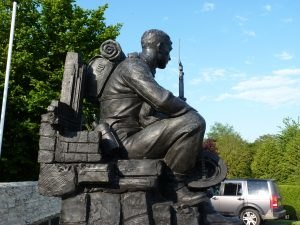 beaches we skirted Crépon, were we came across the impressive memorial to the Green Howards. It is of a soldier in full kit just taking a 5 minute “time out” break. It’s a wonderfully evocative memorial . A weary soldier thinking back to the past few hours, thankful for being alive. A number of “The Men in the Shed” belonged to the Green Howards.
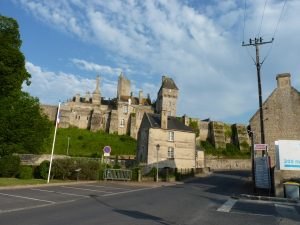
Continuing our journey, we arrived at Creully. Here are both the memorial to the 4th/7th Royal Dragoon Guards (a Sherman tank unit, part of 8th Armoured Brigade, supporting 50th Division) and the Chateau which became Montgomery’s HQ in Normandy. From 7 June 1944, the day after D-Day, until 21 July, it housed the BBC war correspondents and their radio studio. The BBC transmitted the first news of the Battle of Normandy from there.
Fully sated with history, we returned to our hotel for beer and food!
 the large embankment of what was the major railway running into Caen. This is the one the tanks of 3rd Royal Tank Regiment went behind as recounted yesterday.
 n reinforcements from 1st SS Panzer Division counter attacked during the afternoon of 18th July 1944.
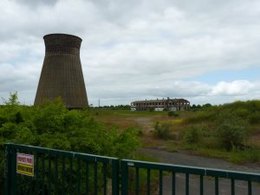
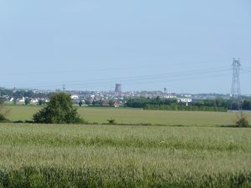 the distance, we could see the remaining cooling tower of the Colombelles Steel factory. From that, and its fellow towers, German observers were able to overview the whole battlefield.
 ere then
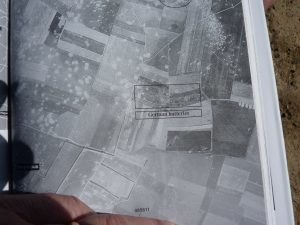 followed a second visit to “von Luck’s 88’s” having re-read the books. This allowed us to make a better identification of their location. We also re-appraised the location of where the two German Tiger tanks had been destroyed by anti-tank gun fire. At the point identified we found a small piece of what appears to be substantial pipework (perhaps from a cooling or fuel system) to reinforce this. Although, to be fair, a closer look at the maps & aerial photographs did help!!
 Gorman of the Irish Guards in his Sherman tank “Ballyragget”. With the rest of his regiment having passed the farm of le Prieuré, Gorman then got bogged down. He was left behind in the boggy ground by the Ruisseau de Cagny – a small stream. Fortunately for us, there’s a bridge!
 it could, I guess be compared to Gorman’s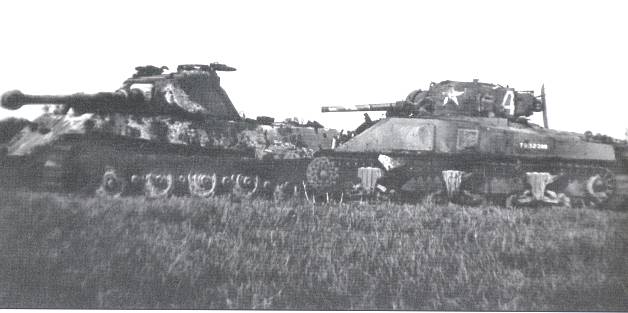
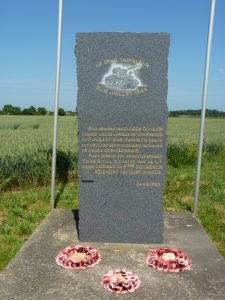 to the road. Then turned left to have a look at the Guards’ memorial which refers to Gorman destroying of the first King (or Royal) Tiger in Normandy. We then crossed the new motorway to view the site of the ramming.
 with excellent historical detail and maps, as well as well-planned battlefield tours.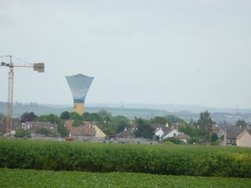
 art point.
 aph on page 148 of my copy of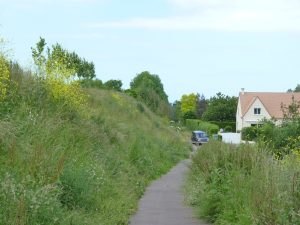
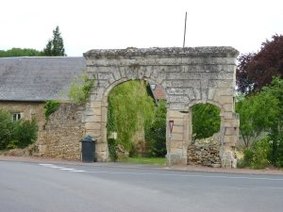 econd part of the tour (or the next tour as it is in the book). We stopped first at the CWGC Cemetery just outside of Sannerville. As we were leaving, a team from the CWGC arrived to cut the grass. We spoke to them and they gave us a booklet explaining the work that they do. As we carried on we realised that we’d been down this road before as we recognised the imposing ruin of the gateway to Troan Abbey. On the previous occasion its significance had escaped us.
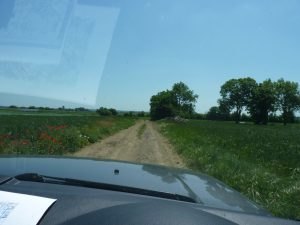
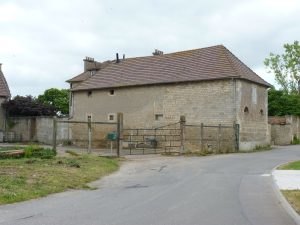 Ferme, we made use of the off-road capability of my car as the road moved from being tarmacked into just a dirt track. It evoked the state that many of the roads in wartime France would have been in. We
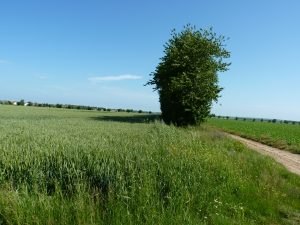
 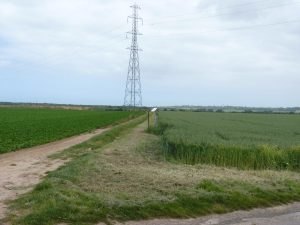 were on the hunt for the location where two German tanks had been destroyed – potentially by their own guns in a mistaken act of “friendly fire”. Why it’s termed that, I don’t really understand, as it’s hardly friendly!! Also the location of the
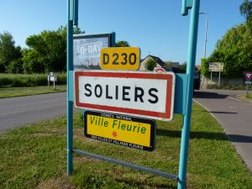
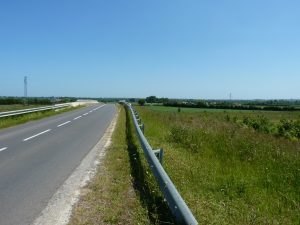
 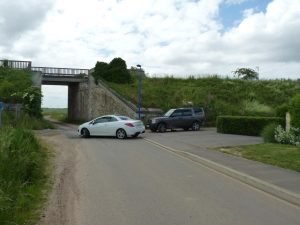 embankment has now been converted into a cycleway & footpath. From the top you get some excellent views across the battlefield. Toward the large village of Soliers and, between 2 & 3 KM away, the final targets: the villages of Ifs/Bras Hubert-Folie and Bourguébus itself. We had a large-scale detailed map, binoculars, a sunny day. There were no explosions going off or people shooting at us. Yet it was still difficult to orientate on these places. I just can’t imagine doing so from the turret of a tank in the heat of battle!
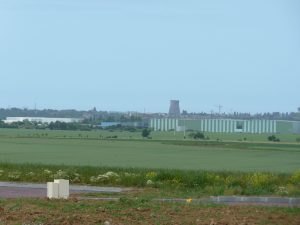 locked off route out of the village, allowed us to look back over the battlefield. From here we could see the water- and cooling-towers that we had noted earlier in the day.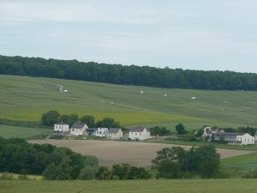
 ple crosses for the majority of burials but “proper” headstone for those of the Jewish religion. It’s generally forgotten how many Jews fought for Germany in the First World War given what happened to them during the Second. The other surprise is that there are 4 burials per cross!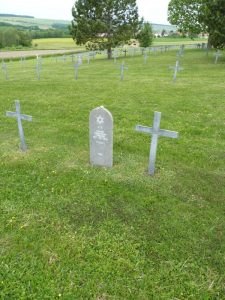
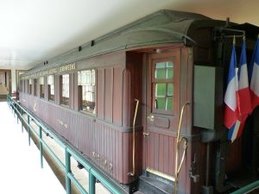 te was used again in 1940
 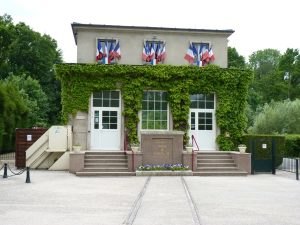 for France’s formal surrender to the Germans. In the very same railway carriage that had been employed for the 1918 signings. There’s now a
 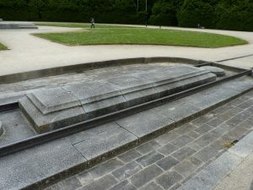 iginal was taken to Berlin where it was put on display. It had been destroyed in 1945. Markers outside the museum show the location of the various carriages in 1918.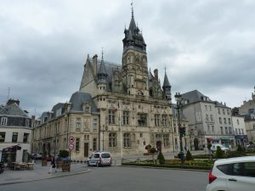
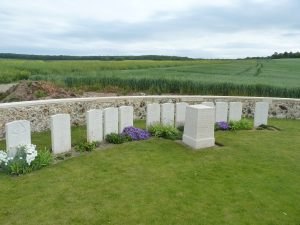
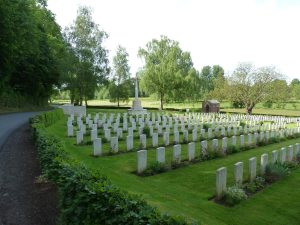 topped for a short while to pay our respects. Once again, we were approaching that part of the world where it seems that Commonwealth War Graves Commission Cemeteries (CWGC) replace milestones as there are so many.
 nts – with relative ease. Not at all like our usual visits!!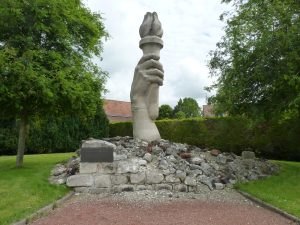
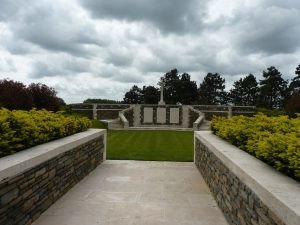 otting a small sign for the Lichfield Crater we decided to investigate. Lichfield being a place in the Midlands not far from where I used to live – home for us of pitch and putt golf and Merrie Monk from Marston’s (you guessed – a beer – itself now history). This was an unusual site for a CWGC site in that it made use of the crater left behind following the detonation of a large mine under the German defensive line. On our way towards the crater, we passed by indications that the war really hasn’t gone away from this area – signs for unexploded ordnance. The signs denote that is the “Red Zone” a part of France that’s unlikely to ever be clear of the effect of war.
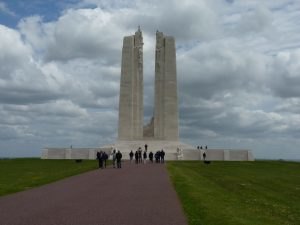 ld War, there were rumours circulating that the Germans had destroyed it. In fact, it was Hitler’s favourite First World War Memorial as it depicted peace not war. So, he had photos of himself taken by it in order to show that it was undamaged He then arranged for troops from the SS to guard it – from both the Allies AND the German army – to ensure that it wasn’t defaced!
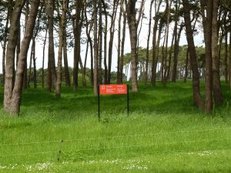 ar. Trees have been planted to try to soften the view, but trench lines and mine explosions can still clearly be seen. As can many “Red Zone” warning signs – right next to the paths! Interestingly, sheep graze on the land… I wonder how many are lost each year?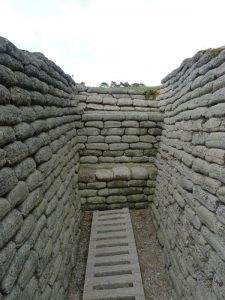
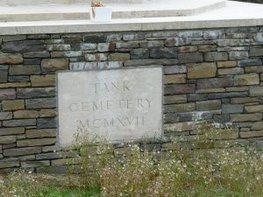 was aware that some had been noted near to the village of Héninel. Unfortunately, we were unable to find these. I did some further research on our return to the UK. I found out where they are & realised that we got quite close!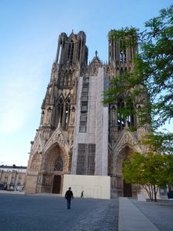
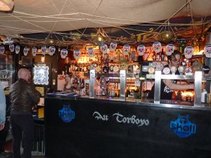 our journey towards Reims. That night we had a ramble around the town. Where we were saw the Cathedral and were able to find an interesting bar… amongst many!
 op this year was a return visit to the
  ntly, we stayed our first night at the Ibis Styles hotel near Bethune at Bruay la Buissière. You’ll notice that almost next door is a Trois Brasseurs brewpub. However, this was purely coincidental and had absolutely no impact on our hotel choice… honest.